
Rates · October 2026
Business Loan Interest Rates in October 2026: Average Rates by Product and Lender
Business loan interest rates in October 2026 range from about 7% at a bank to the equivalent of 60% or more on a short merchant cash advance, and the spread is wider than it has been in years. Two things moved this fall: the Federal Reserve raised rates on September 17 for the first time since 2023, taking the prime rate to 7.00%, and the Kansas City Fed’s latest bank survey (released September 24) shows bank pricing on term loans and lines had been drifting down before that. This page lays out current rates by product and lender type, what drives your rate, and how to compare offers that are quoted three different ways.

What Is the Average Business Loan Interest Rate Right Now?
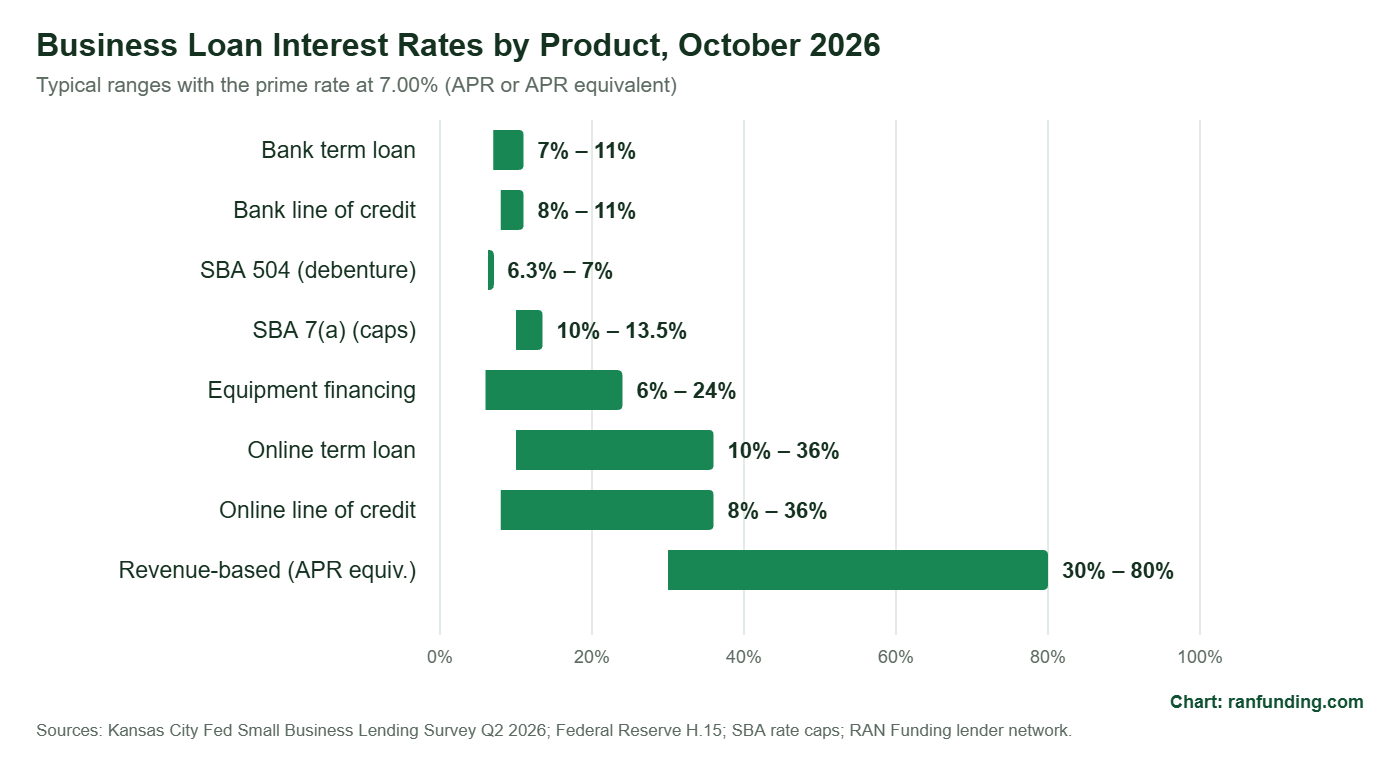
With the prime rate at 7.00%, average business loan interest rates in October 2026 are roughly: bank term loans 7% to 11% (the Kansas City Fed’s Q2 2026 survey put the median rate on new bank term loans at about 6.7% to 7.0% before the September hike, so about 7% to 7.25% now); bank lines of credit Prime plus 1 to 4, or 8% to 11%; SBA 7(a) loans 10.00% to 13.50% (the caps are Prime plus 3.0 to 6.5 by loan size); SBA 504 debentures about 6.3% to 7.0% fixed; online term loans 10% to 36% APR for most files and 22% to 50% for weaker ones; online lines of credit 8% to 36% APR equivalent, usually quoted as a 1.5% to 3% draw fee; equipment financing 9.9% to 24%; invoice factoring 1% to 4% per 30 days; and revenue-based financing or merchant cash advances a factor rate of 1.15 to 1.50, which works out to 30% to 90% APR equivalent depending on the term. Your rate inside those ranges is set by credit, time in business, revenue, collateral and term.
Business Loan Interest Rates by Product, October 2026
| Product | Typical rate or cost | How it is quoted | What moves it |
|---|---|---|---|
| Bank term loan | 7% – 11% | Fixed or variable APR | Prime, credit, collateral, term |
| Bank line of credit | Prime + 1 to 4 (8% – 11%) | Variable, interest-only | Prime, relationship, financials |
| SBA 7(a) | 10.00% – 13.50% (caps) | Variable or fixed APR | Prime, loan size |
| SBA 504 | 6.3% – 7.0% fixed | Fixed for 10 – 25 years | Treasury yields |
| SBA Express line | Up to 13.50% | Variable | Prime + up to 6.5 |
| Online term loan | 10% – 36% APR (22% – 50% weaker files) | APR or simple interest | Credit, revenue, term |
| Online line of credit | 8% – 36% APR equiv. | 1.5% – 3% fee per draw | Credit, deposits, repayment term |
| Equipment financing | 9.9% – 24% | Fixed APR | Credit, equipment age, term |
| Invoice factoring | 1% – 4% per 30 days | Discount fee | Customer credit, volume |
| Revenue-based financing | Factor 1.15 – 1.45 (30% – 80% APR equiv.) | Factor rate | Deposits, term, positions |
| Merchant cash advance | Factor 1.15 – 1.50 (35% – 90%+ APR equiv.) | Factor rate | Card volume, term, positions |
Bank figures are from the Federal Reserve Bank of Kansas City’s Small Business Lending Survey for the second quarter of 2026 adjusted for the September 17 prime rate increase; SBA caps are the SBA’s published maximums at a 7.00% prime; online and revenue-based ranges are what our lender network has offered in October 2026. See the product-level pages for lender-by-lender detail: line of credit rates, SBA loan rates, equipment financing rates.
Rates by Lender Type
| Lender type | Term loan | Line of credit | Share of 2026 applicants | Fully approved | Paid more than expected |
|---|---|---|---|---|---|
| Small bank | 7% – 10% | 8% – 10% | 28% | 57% | 37% |
| Large bank | 7% – 11% | 8% – 11% | 41% | n/r | 38% |
| Credit union | 7% – 10% | 8% – 10% | 7% | 44% | n/r |
| SBA lender | 10.00% – 13.50% | Up to 13.50% | — | 37% (SBA products) | — |
| Online lender | 10% – 36% APR (to 50%) | 8% – 36% APR equiv. | 29% | n/r | 60% |
| Revenue-based funder | Factor 1.15 – 1.50 | — | 8% (MCA applicants) | 48% (MCA) | n/r |
The last two columns are from the Federal Reserve’s 2026 Small Business Credit Survey: 60% of online-lender borrowers reported paying more than expected, against 37% at small banks, which is a disclosure problem more than a rate problem. Insist on the total payback in writing before you sign.
Who paid more than they expected, by lender type (Federal Reserve, 2026)
Share of borrowers reporting the cost was higher than expected. Source: Federal Reserve Banks, 2026 Report on Employer Firms.
What Changed This Fall
- Prime rose to 7.00% on September 17, 2026, the first increase since 2023. Every variable-rate bank line, SBA 7(a) loan and HELOC repriced within a billing cycle; fixed-rate loans and factor-rate products did not move.
- Bank pricing had been easing before the hike. The Kansas City Fed’s Q2 2026 survey (released September 24) found median variable rates on new rural term loans down 80 basis points year over year and variable line rates down about 92 to 94 basis points, with urban variable term rates the highest at about 7%.
- Banks are lending more through lines. New credit line balances rose 20.9% year over year in Q2 2026 against 4.5% for term loans, and about 8% of banks on net were still tightening standards.
- Next decision: October 28. Futures price roughly a two-in-three chance of a hold and a majority chance of another quarter-point in December. A hike moves bank and SBA variable rates up a quarter point; it does not change online fixed pricing or factor rates. Scenarios are in prime rate is 7%: what it means for business loan rates.
What Sets Your Rate Inside the Range
| Factor | Effect on rate | Example |
|---|---|---|
| Personal credit | Largest single factor under $500K | 720+ gets bank pricing; 600 – 650 gets online pricing; under 600 gets factor rates |
| Time in business | Under 2 years excludes most bank pricing | 6 – 12 months: online and revenue-based only |
| Revenue and deposits | Sets amount more than rate | NerdWallet’s 2026 study: 80% of approved sub-660 borrowers had $500K+ revenue |
| Collateral | 2 – 6 points lower when pledged | Equipment loans at 9.9% vs unsecured term at 18% |
| Term | Shorter terms cost less in total, more per year | A 6-month MCA at 1.25 is 50%+ APR equiv. |
| Existing positions | 5 – 15 points higher, or declined | Two open advances push most files to second-position pricing |
| Industry | Restaurants, trucking, construction price higher | Higher failure rates and seasonality |
NerdWallet’s 2026 study of approved marketplace loans found 55% of borrowers had credit of 700 or more and a median business age of seven years; those are the files getting the low end of each range.
How to Compare Rates Quoted Three Different Ways
Banks quote APR, online lenders quote APR or simple interest, and revenue-based funders quote a factor rate. The only fair comparison is total cost over the same period.
| $100,000 offer | Quoted as | Total cost | APR equivalent |
|---|---|---|---|
| Bank term loan, 3 years | 9% APR | $14,500 | 9% |
| Online term loan, 12 months | 18% simple interest | $18,000 | ~32% |
| Online line, drawn 12 months | 2.5% per draw, 12-month amortization | $11,000 | ~22% |
| Revenue-based, 9 months | Factor 1.25 | $25,000 | ~68% |
| Merchant cash advance, 6 months | Factor 1.35 | $35,000 | ~130% |
Convert any quote with the factor rate calculator and read factor rate vs APR before signing a revenue-based offer. Ten states, including Florida, New York and California, now require lenders to disclose total cost on commercial financing of $500,000 or less; see disclosure laws by state.
How to Get a Lower Business Loan Rate
- Bring collateral or a specific use. Equipment and receivables-backed loans price 2 to 6 points under unsecured.
- Clear open advances first. Nothing raises a rate faster than stacked positions.
- Match the product to the need. A line for recurring gaps, a term loan for purchases; using an MCA for a 12-month need costs three to five times more.
- Compare lenders on one application. The same file draws different offers from different lenders; RAN Funding shows them side by side.
- Ask for the total payback and a prepayment discount in writing; many online lenders waive remaining interest on early payoff.
Share of applicants fully approved, by product (Federal Reserve, 2026)
81% of applicants were approved for at least part of the request. Source: Federal Reserve Banks, 2026 Report on Employer Firms.
Embed This Chart
These charts are published for reuse by journalists, researchers, accountants and business publications. Each one cites its public data source and may be embedded or reproduced with attribution to RAN Funding and a link to the source page; a high-resolution PNG is at the image link. Figures are refreshed on the schedule in how we compare and rank lenders.
Free to reuse in articles, presentations and reports with a link back to the source page. Copy the code:
¿Prefiere español? Lea esta guía en español.
Common Questions
What is a good interest rate on a business loan in 2026?
For an established business with 700+ credit, 7% to 11% at a bank or 10% to 13.5% on an SBA 7(a) loan is a good rate in October 2026. For a business under two years old or with credit under 650, 15% to 30% APR from an online lender is typical, and a factor rate under 1.25 is good for revenue-based financing.
What is the current prime rate and how does it affect business loans?
The prime rate is 7.00%, set on September 17, 2026 after the Federal Reserve raised its target range. Bank lines of credit, SBA 7(a) loans and other variable-rate loans are priced as Prime plus a margin, so each quarter-point Fed move changes those rates by a quarter point. Fixed-rate loans and factor-rate products are unaffected.
Are business loan interest rates going up or down?
Up slightly. Prime rose a quarter point in September 2026 after bank pricing had eased through the first half of the year, and markets expect another quarter point by December. Online lender pricing and factor rates are driven more by credit risk than by the Fed and have been stable.
Why are online business loan rates so much higher than bank rates?
Online lenders approve files banks decline (under two years in business, credit under 680, no collateral) and fund in days instead of weeks, which means more defaults and higher pricing. In 2026, 29% of applicants used an online lender and 60% of their borrowers said the cost was higher than expected, so compare total payback before accepting.
Is a factor rate the same as an interest rate?
No. A factor rate is a multiplier on the amount advanced (1.25 on $100,000 means $125,000 repaid) with no compounding and no benefit from early payoff unless a discount is offered. Because the term is short, a 1.25 factor over nine months is roughly a 68% APR equivalent. Use the factor rate calculator to convert.
Is RAN Funding a lender?
No. RAN Funding is a business financing broker. We present your application to our lender network and show you the offers you qualify for; the funding partner sets the approval, amount, rate, fees and terms.
Sources
- Small Business Lending Survey, Second Quarter 2026 (released September 24, 2026) — Federal Reserve Bank of Kansas City
- H.15 Selected Interest Rates (bank prime loan rate 7.00%) — Board of Governors of the Federal Reserve System
- 2026 Report on Employer Firms: Findings from the 2025 Small Business Credit Survey — Federal Reserve Banks
- 2026 NerdWallet Business Loan Study — NerdWallet
- SBA 7(a) maximum interest rates — U.S. Small Business Administration
See What You Qualify For
One application, about five minutes, soft pull only. A funding specialist tells you up front which products fit your file, what they cost and how fast each one funds.
More on Rates and Costs