
Business loans · Approval odds
Business Loan Approval Rates in 2026: Your Odds by Loan Type, Lender and Credit Profile
Four in five small businesses that applied for a loan, line of credit or cash advance in the past year were approved for at least some of it, but fewer than half got the full amount. The Federal Reserve’s 2026 Small Business Credit Survey, the largest survey of its kind, breaks those odds down by product and lender type. This guide puts the numbers in one place and shows what moves a file from “partial” to “approved in full.”

What Are the Odds of Getting a Business Loan Approved in 2026?
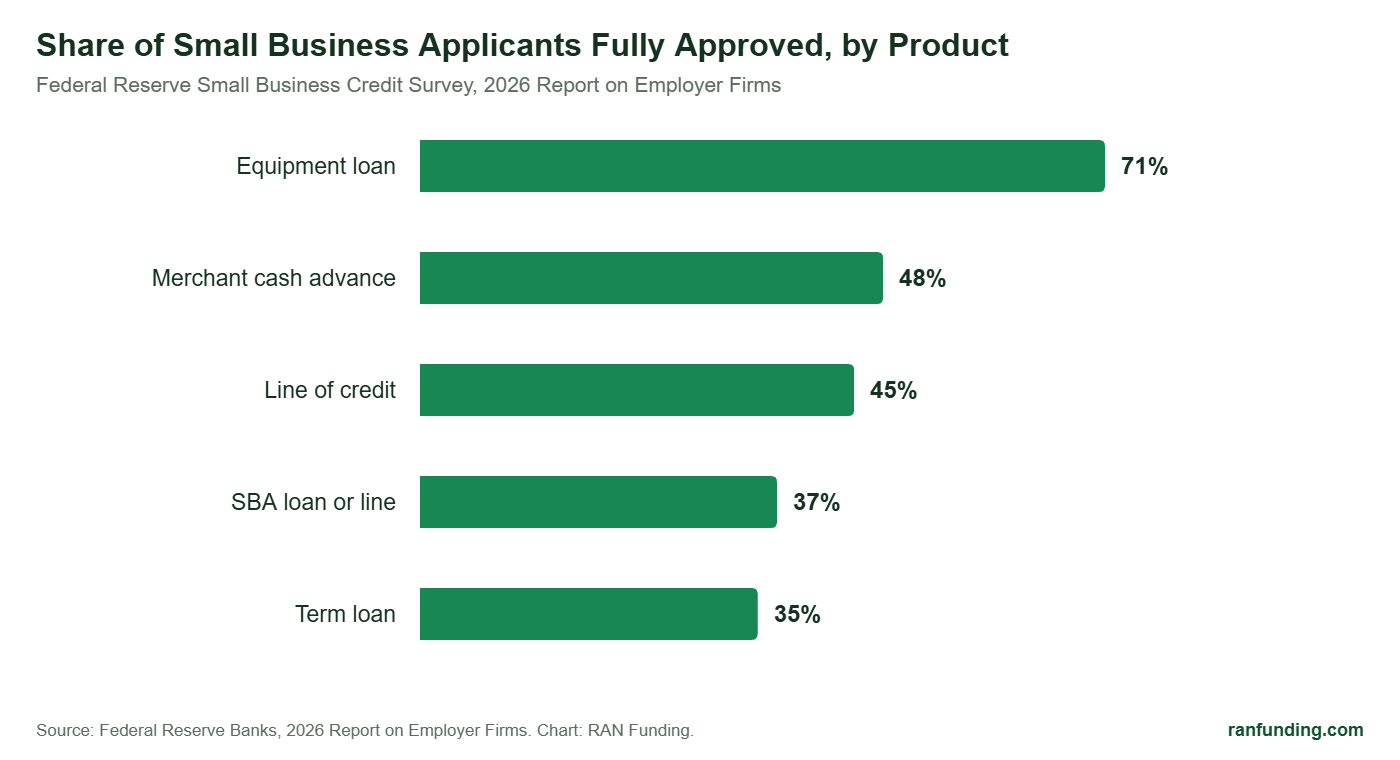
About 81% of applicants were approved for at least part of what they asked for, and 42% received everything. Odds vary widely by product: auto and equipment loans were fully approved 71% of the time, merchant cash advances 48%, business lines of credit 45%, SBA loans 37% and plain business term loans 35%. By lender, small banks fully approved 57% of applicants, the highest of any source the survey reports. The surest ways to improve your odds are applying for the product that matches your file, keeping business deposits in a business account, and asking for an amount your cash flow visibly supports.
Approval Odds at a Glance
The Fed’s 2026 report is based on 6,525 employer firms surveyed between September and November 2025. Of all firms, 60% sought some type of financing during the year. Among those that did not apply, 63% said they did not need it, 17% said credit was too expensive, and 7% were discouraged, meaning they expected to be turned down and did not try. Discouraged owners most often blamed weak business financials. Broader context on what the survey says about the year is in our 2026 small business lending trends guide.
Approval Rates by Loan Type
| Product | Fully approved | Partially approved | Denied | Applicants (N) |
|---|---|---|---|---|
| Auto or equipment loan | 71% | 17% | 11% | 294 |
| Mortgage | 55% | 23% | 22% | 137 |
| Merchant cash advance | 48% | 40% | 12% | 298 |
| Business line of credit | 45% | 31% | 24% | 977 |
| Personal loan | 40% | 31% | 30% | 157 |
| SBA loan or line of credit | 37% | 35% | 28% | 359 |
| Business loan (term) | 35% | 35% | 30% | 683 |
| Home equity line of credit | 32% | 29% | 40% | 110 |
Share of applicants fully approved, by product (2026 Fed SBCS)
Source: Federal Reserve Banks, 2026 Report on Employer Firms, approval outcomes by product.
Two patterns stand out. Collateral drives full approvals: an equipment loan is secured by the equipment and a mortgage by the property, so lenders say yes to the whole amount far more often. And merchant cash advances are rarely denied outright (12%) but are the most likely product to be cut down (40% partial), because funders size the advance to recent deposits rather than to the amount requested. The unsecured products that most owners ask for first, term loans and SBA loans, are the hardest to get in full. How each product is underwritten is covered in business loan requirements.
Approval Rates by Lender Type
| Lender | Fully approved | Partially approved | Denied | Share of applicants |
|---|---|---|---|---|
| Small bank | 57% | 23% | 20% | 28% |
| Finance company | 50% | 31% | 19% | 14% |
| Credit union | 44% | 26% | 29% | 7% |
| Large bank | Not reported here | 41% | ||
| Online lender | Not reported here | 29% |
Large banks still receive the most applications (41%), but small banks produce the most full approvals (57%) and the second-highest satisfaction (65%). Online lenders are now the second most common place to apply, chosen for speed and perceived odds, yet they score the lowest satisfaction (35%) and the biggest cost surprise: 60% of online-lender borrowers said the financing cost more than they expected, against 37% at small banks and 32% at large banks. The lesson is not to avoid online lenders, which fund files banks will not, but to know the total cost before signing. Our factor rate vs APR guide shows how.
Borrowers who said costs were higher than expected, by lender type
Source: Federal Reserve Banks, 2026 Report on Employer Firms.
What Applicants Asked For, and Why
Most requests are modest. Thirty-seven percent of applicants sought $50,000 or less, and only 8% asked for more than $1 million.
| Amount sought | Share of applicants |
|---|---|
| $25,000 or less | 21% |
| $25,001 – $50,000 | 16% |
| $50,001 – $100,000 | 22% |
| $100,001 – $250,000 | 19% |
| $250,001 – $1 million | 14% |
| More than $1 million | 8% |
The reasons for applying tell you what lenders are actually funding this year: operating expenses (56% of applicants), refinancing or paying down debt (46%), expansion or a new opportunity (42%), credit to have on hand (28%) and repairs or replacing equipment (26%). Nearly half of applicants borrowing to refinance is a sign of how many businesses are carrying expensive short-term debt; if that is you, see reverse consolidation and the new SBA refinancing rules effective October 2026.
What Lenders Look at Before They Say Yes
The survey shows that 59% of firms with debt had signed a personal guarantee and 38% had pledged personal assets, so the owner’s own credit and finances are on the table in most approvals. The Fed classifies 72% of employer firms as low credit risk, 22% medium and 6% high, which lines up with what marketplace data shows about who actually gets funded: in NerdWallet’s 2026 study of approved loans, 55% of borrowers had personal credit scores of 700 or higher, the median business had been operating seven years, and borrowers received on average 75% of the amount they requested. Among approved borrowers with scores of 659 or below, 80% had at least $500,000 in annual revenue, which is the trade-off in plain sight: weaker credit gets approved when revenue is strong.
- Deposits: three to six months of business bank statements decide most approvals under $500,000. Steady deposits beat high but lumpy ones.
- Time in business: two years opens banks and SBA lenders; six months opens revenue-based products. Under six months, expect partial approvals at best.
- Personal credit: 680+ for bank and SBA pricing, 600 to 650 for most online term loans and lines, 500+ for revenue-based financing.
- Existing debt: stacked daily-payment advances are the most common reason a strong-looking file is cut down or declined.
- Amount requested vs cash flow: lenders approve what the business can repay, not what it asks for. Requests above roughly 10% to 15% of annual revenue are often reduced.
- Collateral: equipment, receivables or real estate turn a partial approval into a full one.
How to Improve Your Approval Odds
- Apply for the product that fits your file. A 500-credit, high-deposit business should not start with an SBA application; a 720-credit, two-year-old business should not accept a cash advance.
- Ask for the amount your deposits support. Partial approvals are usually a sizing decision; a right-sized request is approved in full more often.
- Clean the statements before you apply. Fewer NSFs, no personal spending through the business account, and three months of steady balances.
- Pay down or consolidate stacked advances first. One payment instead of three changes the lender’s view of your cash flow immediately.
- Offer collateral where you have it. Equipment and receivables are the difference between the 35% and 71% rows in the table above.
- Apply once, to several lenders, with one soft pull. A broker shows you which lenders say yes to the whole amount before any hard inquiry.
Embed This Chart
These charts are published for reuse by journalists, researchers, accountants and business publications. Each one cites its public data source and may be embedded or reproduced with attribution to RAN Funding and a link to the source page; a high-resolution PNG is at the image link. Figures are refreshed on the schedule in how we compare and rank lenders.
Free to reuse in articles, presentations and reports with a link back to the source page. Copy the code:
Common Questions
What percentage of small business loans are approved?
In the Federal Reserve’s 2026 Small Business Credit Survey, 81% of applicants for a loan, line of credit or merchant cash advance were approved for at least part of the request, and 42% received the full amount.
Which business loan is easiest to get approved for?
By full-approval rate, auto and equipment loans (71%) lead because they are secured by the asset. Merchant cash advances are the least likely to be denied outright (12%), though 40% of applicants receive less than they asked for.
How hard is it to get an SBA loan?
SBA loans and lines were fully approved for 37% of applicants, partially approved for 35% and denied for 28% in the 2026 survey. SBA lenders typically want two or more years in business, personal credit around 680 or higher and cash flow that covers the payment.
Which lenders approve the most business loans?
Small banks fully approved 57% of applicants, the highest share reported, followed by finance companies at 50% and credit unions at 44%. Online lenders are chosen for speed and the chance of being funded, but 60% of their borrowers reported costs higher than expected.
What credit score do I need to get a business loan approved?
It depends on the product: about 500 for revenue-based financing and merchant cash advances, 600 to 650 for most online term loans and lines of credit, and 680 or higher for bank and SBA loans. Strong revenue can offset a lower score; most approved borrowers with scores under 660 had at least $500,000 in annual revenue.
Is RAN Funding a lender?
No. RAN Funding is a business financing broker. We present your application to our lender network and show you the offers you qualify for; the funding partner sets the approval, amount, rate, fees and terms.
Sources
- 2026 Report on Employer Firms: Findings from the 2025 Small Business Credit Survey — Federal Reserve Banks (Small Business Credit Survey)
- 2026 NerdWallet Business Loan Study: data reveals what it takes to qualify — NerdWallet
- Small Business Credit Survey — Federal Reserve Banks
See What You Qualify For
One application, about five minutes, soft pull only. A funding specialist tells you up front whether SBA is realistic for your file — and which faster products fit if it is not.
More on Qualifying for Business Funding